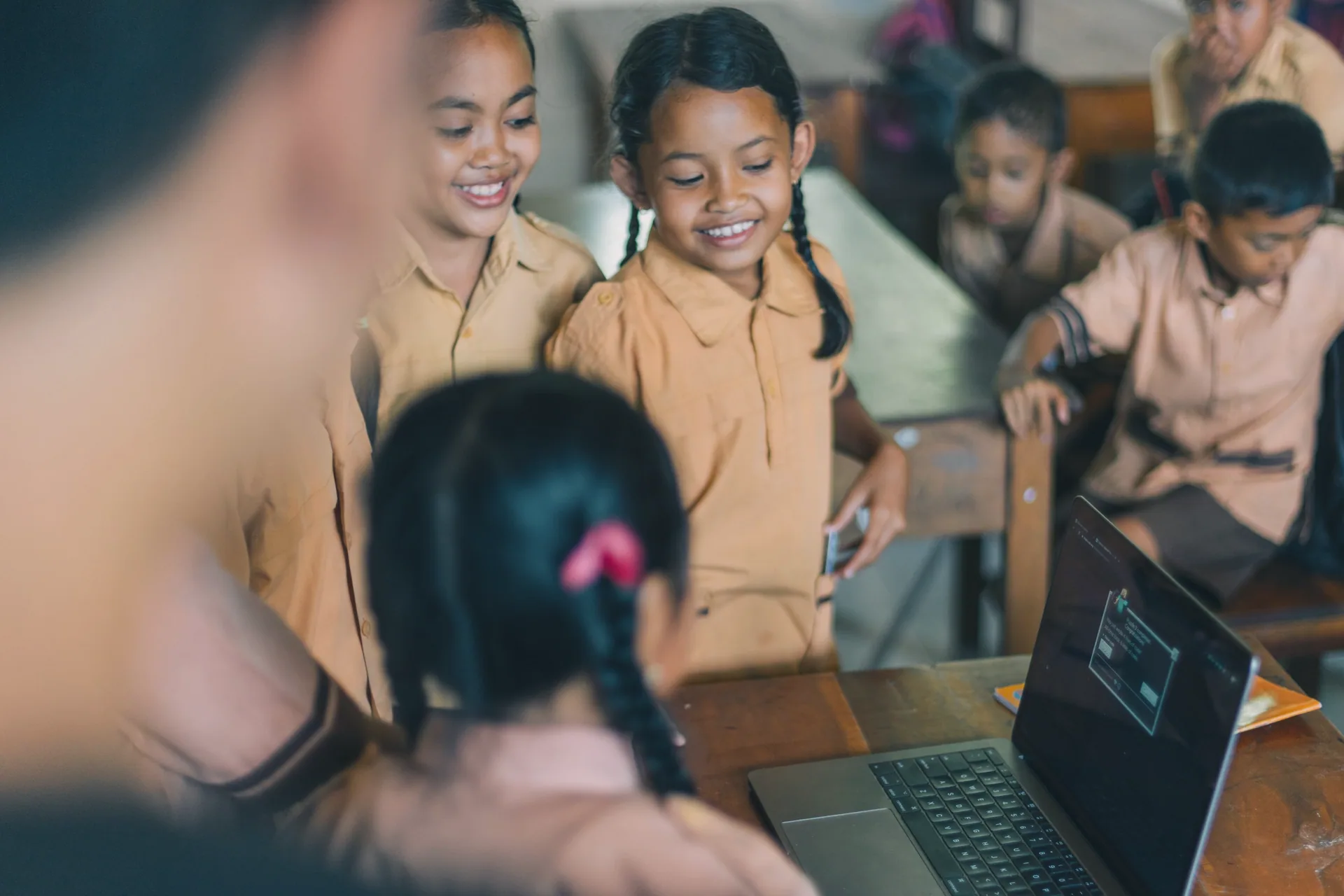
AI classes for kids in Singapore are worth taking when they teach how AI works, not only how to prompt a chatbot. Younger children learn through hands-on activities about patterns and examples; older children can train simple models and test them. MOE advises against direct AI tool use in Primary 1 to 3.
Search for AI classes in Singapore and the label can cover anything from a robotics club to a prompt-writing workshop. The pressure behind the search is real. Singapore's second National AI Strategy, launched in December 2023, set out to raise up individuals, businesses and communities to use AI with confidence, discernment and trust. Parents reasonably want their children to be among them. The harder question is what a child can actually learn about AI at six, nine or fourteen, and which classes are simply a chatbot with a timetable.
What Singapore Schools Already Teach
Start with what your child will meet at school, because a good class should build on it rather than repeat it. The Ministry of Education describes its approach as the Four Learns: learn about AI, learn to use AI, learn with AI and, most importantly, learn beyond AI, which means developing the competencies and values that keep students distinctly human in ways AI cannot replicate. Self-paced AI literacy modules are available to students on the Singapore Student Learning Space. In October 2024, IMDA and MOE also announced AI for Fun, elective modules of five to ten hours to be made available to all primary and secondary schools from 2025. In one example, students get to understand what a smart robot is and train such robots to respond to external signals.
MOE is just as careful about age. Its quick guide for parents, updated in October 2025, says that in Primary 1 to 3, concrete hands-on learning and social interaction should come first, and that direct use of AI tools by students is not advisable, because young children may not be able to judge the output and may mistake AI for a human. From Primary 4 to 6, AI can be introduced gradually under a teacher's guidance, with chatbot use supervised. In secondary school, responsibility is released step by step.
What Children Can Really Learn At Each Age
For a curriculum view, a useful public framework comes from AI4K12, an initiative sponsored by the Association for the Advancement of Artificial Intelligence and the Computer Science Teachers Association. It organises AI around five big ideas: computers perceive the world using sensors, agents keep representations of the world and reason with them, computers can learn from data, natural interaction with people requires many kinds of knowledge, and AI can affect society in both positive and negative ways. Its draft progression chart for learning from data sets out what is realistic by grade band. The bands are American school grades, so the ages below are approximate.
- About 5–8
- Realistic GoalUnderstand that computers learn differently from people
- What It Looks LikeSorting labelled pictures to find the features that predict a label, and helping a teacher train a computer to recognise gestures or sounds
- About 8–11
- Realistic GoalTrain a simple classifier and test it on new inputs
- What It Looks LikeLabelling examples, noticing where the model gets things wrong and adding training data to improve it
- About 11–14
- Realistic GoalTrain and evaluate a model on a table of data
- What It Looks LikeExplaining the difference between training a model and using one
- About 14–18
- Realistic GoalUse supervised or unsupervised learning on real data
- What It Looks LikeMeasuring a model's accuracy on a test set it has never seen
Notice what is missing from the early bands: chatting with a generative AI tool. A six-year-old who discovers that a computer learns from labelled examples, and makes wrong predictions when those examples are flawed, is learning more about AI than one asking a chatbot to write a story.
Perception is often the friendliest way in. AI4K12 describes it as extracting meaning from sensory signals, and counts making computers see and hear well enough for practical use among the field's most significant achievements. For a child, a small robot that stops at a line or turns towards a clap is a first working example of that idea, and it echoes the smart robots in the AI for Fun modules. Children can build it, test it, watch it get things wrong and work out why.
Why A Chatbot Is Not A Class
MOE's guide for parents explains the risk plainly. Generative AI predicts the most likely answer, so it can sound confident even when it is wrong, and it responds like a person without truly understanding or feeling anything. Its advice for families is practical: explore AI tools together, never share personal details such as a full name, address or school, and at primary level ask permission before trying a new AI tool. The ministry's own summary makes a good test for any class: AI should support your child's learning and not replace their own thinking.
Screens matter too. Singapore's Ministry of Health advises that children aged 7 to 12 keep screen use under two hours a day outside schoolwork. An AI class that spends most of its time on laptops uses up much of that allowance. One that mixes unplugged sorting games, robots that respond to sensors and short, supervised screen work fits the guidance far better.
Six Signs Of A Real AI Class
- It explains how, not only what. Children learn about training data, patterns and why a model makes mistakes
- It starts with hands, not chat windows. Unplugged sorting, labelling games and robots that respond to sensors come before open-ended screen time
- It matches tools to age. No direct chatbot use for young children, supervised use for older primary pupils and more independence in the teens
- It teaches healthy doubt. Students check outputs against other sources and talk about how biased training data can leave some people less well served
- It ends with something made. A trained model, a responsive robot or a project your child can explain to you
- It protects privacy. Children never type names, addresses or school details into AI tools
UNESCO's AI competency framework for students, published in 2024, describes the same progression in three levels, understand, apply and create, across four dimensions that include a human-centred mindset and the ethics of AI. A class that only ever asks children to apply AI tools has skipped the first step and the last.
Where AI Fits In The OpenKids Journey
At OpenKids, AI sits within Tech Programmes for ages 4 to 18, with curriculum by Futurum Academy. Children are placed by readiness, not birthday, so where your child starts depends on how they think rather than the year they were born. Children who want to go further can move into competition training within the same programme, for ages 8 to 24 by readiness, with curriculum by AK Robotics. Tech Programmes and Art Programmes are the two programme systems that form one growth journey from age 3 to 24. If your child is younger, our guide to coding classes for 7-year-olds is a natural first read.
The first trial class is free, and every fee is shown in writing before your family decides. OpenKids has campuses in Singapore and Kuala Lumpur. A campus replies on WhatsApp within 48 hours, and HQ on +65 8990 1988 replies the same day. Take the six signs above to the trial and ask the teacher to show you each one.
Frequently Asked Questions
What age can children start learning about AI?
Children can grasp simple ideas about AI from about five or six, such as the fact that computers learn from labelled examples. At that age learning should be hands-on and teacher-led: MOE's guidance is that direct use of AI tools is not advisable in Primary 1 to 3, with gradual, supervised use from Primary 4.
Should my child use ChatGPT or other AI chatbots?
Follow MOE's age guidance. In Primary 1 to 3, direct use of AI tools is not advisable. From Primary 4 to 6, use can be introduced gradually and should be supervised. Check each tool's age advisory, explore it together, and make sure your child never shares personal details.
Do Singapore schools teach AI?
Yes. MOE's Four Learns approach covers learning about AI, learning to use it, learning with it and learning beyond it, supported by self-paced AI literacy modules on the Singapore Student Learning Space. IMDA and MOE have also announced AI for Fun, elective modules of five to ten hours for primary and secondary schools from 2025.
Is an AI class different from a coding class?
They overlap. Coding builds computational thinking: sequencing, patterns and debugging. An AI class adds how computers learn from data, why they make mistakes and how AI affects people. A good programme connects the two rather than treating AI as a separate trick.
How can I tell whether an AI class is worth it?
Ask what your child will understand, not just what they will use. A worthwhile class explains training data and mistakes, keeps chatbot use appropriate to age, teaches children to check outputs, and ends with something your child made and can explain. A free trial class is the easiest way to see this for yourself.
Can my child try Tech Programmes at OpenKids for free?
Yes. The first trial class is free, and every fee is shown in writing before a family decides. A campus replies on WhatsApp within 48 hours, and HQ on +65 8990 1988 replies the same day.