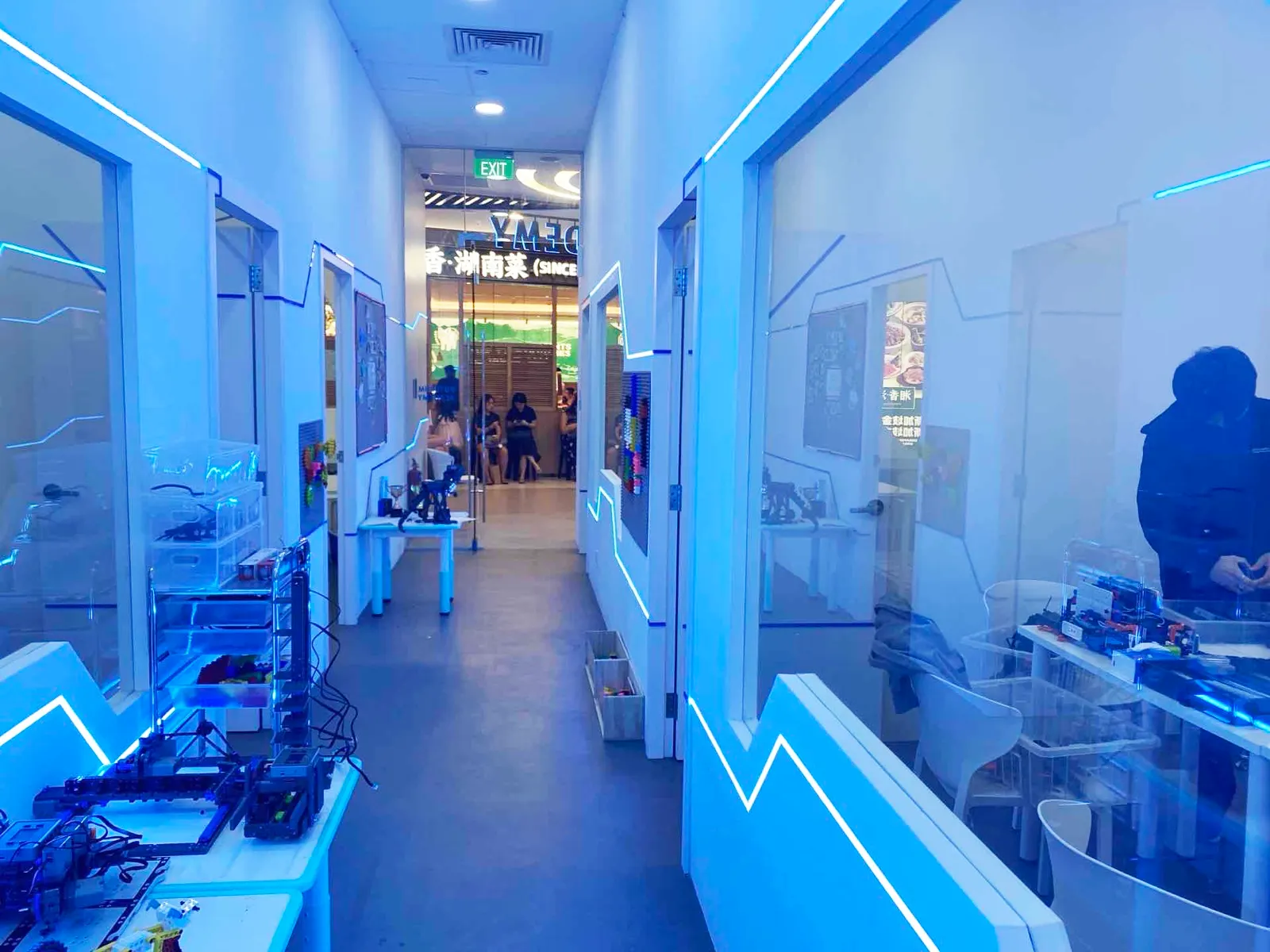
Futurum Academy is a Singapore STEAM education brand established in 2018, teaching AI coding, robotics and 3D design at campuses across Singapore and in Kuala Lumpur. It supplies the curriculum and teaching of OpenKids Tech Programmes under TAFA Group for ages 4–18, and OpenKids students compete at the world's top technology competitions.
Built in 2018, for a curriculum that didn't exist yet
Futurum Academy was established in 2018 on a bet that mainstream schooling would be slow to make: that coding, robotics and design were becoming basic literacy, not electives. It positioned itself as a S.T.E.A.M academy for kids through young adults — science, technology, engineering, art and mathematics taught together, as one discipline of making. Eight years on, the bet reads less like a prediction and more like a description: the academy now teaches at campuses across Singapore and in Kuala Lumpur, with students from around the world.
- Established
- 2018
- Campus Locations
- SG + KL
Projects first, theory in service of them
Futurum's method stands on three named foundations — spiral learning, Bloom's taxonomy and problem-based learning — which in a classroom translates to one rule: every concept is met inside a real project, then revisited at greater depth each year. The tracks are AI coding, robotics and 3D design. A four-year-old builds and animates; a nine-year-old writes Python and trains simple models; a fourteen-year-old engineers a competition robot with a documented design process. The academy's own summary of the intent is the best one:
“Every child arrives as a student. Every graduate leaves as a creator.”
- AI coding — computational thinking from visual blocks to Python and applied AI
- Robotics — the engineering design process, from first build to the competition field
- 3D design — modelling, prototyping and the habit of shipping physical ideas
Proof beyond the classroom
STEAM education is easy to market and hard to prove, which is why work that leaves the classroom matters. Robotics at Futurum runs from a first build to the competition field, and OpenKids students compete at the world's top technology competitions — where a machine either works in front of judges or it does not. This does not settle whether a school is right for your child, but it does show that the teaching is tested outside its own walls.
Where Futurum sits in the OpenKids journey
Inside the OpenKids 3-to-24 pathway, Futurum powers Tech Programmes — the build years, ages 4 to 18, where curiosity becomes code, circuits and real projects. It is also where the ecosystem's engineers begin: children who start with visual coding at four can be writing Python by nine, and from age 8, by readiness, the strongest builders move up into competition training within the same programme. The staircase is continuous by design.
For parents deciding when and where to start, two guides take the questions step by step: coding classes for 7-year-olds, on what a first class should look like, and AI classes for children, on what a child can genuinely learn about artificial intelligence at each age.
Why 'creator, not consumer' is the hill worth defending
Our conviction: the divide that will matter for this generation is not between kids who use technology and kids who don't — every child will use it. It is between children who experience technology as something done to them and children who experience it as something they do. That difference is built young, project by project, in rooms where a broken robot is a Tuesday and shipping something imperfect is normal. A school that graduates creators is not teaching a subject. It is installing a stance towards the world — and a stance, once installed, is very hard to remove.
Frequently Asked Questions
What is Futurum Academy?
Futurum Academy is a Singapore STEAM education brand established in 2018, teaching AI coding, robotics and 3D design at campuses across Singapore and in Kuala Lumpur. It supplies the curriculum and teaching of OpenKids Tech Programmes under TAFA Group, serving ages 4–18.
Do Futurum Academy students take part in competitions?
Yes. Robotics at Futurum runs from a first build to the competition field, and OpenKids students compete at the world's top technology competitions. From age 8, by readiness, the strongest builders progress into competition training within OpenKids Tech Programmes.
What ages does Futurum Academy teach?
Within the OpenKids pathway, Futurum's programme serves ages 4 to 18 — visual coding and maker foundations from 4, Python and AI engineering from around 9, and advanced projects as they grow; competition training opens from age 8, by readiness.