Computational Thinking
AI Coding
Think
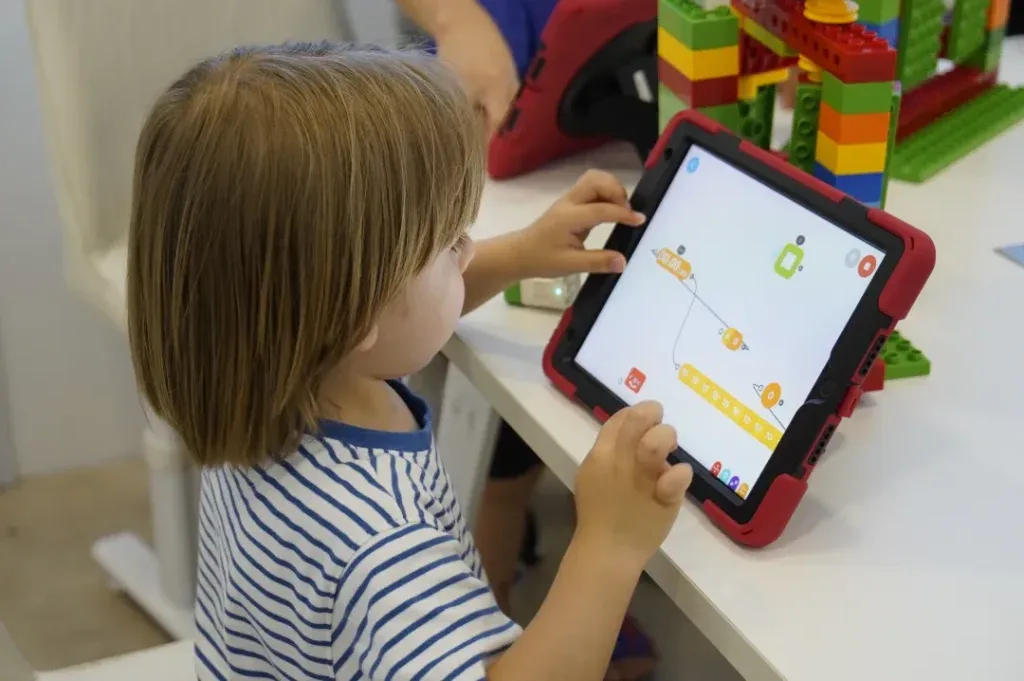
Block coding first, real programming languages and applied AI later. Children learn to break a problem down before they write a line of code.
Levels And Ages
Ages 7–9Foundations
Playful logic and block coding, building the habit of thinking in steps while making things move on screen.
Ages 10–12Builders
Bigger projects, first text-based code, and the jump from following instructions to designing solutions.
Ages 13–15Creators
Real programming languages, applied AI concepts and portfolio projects with genuine complexity.
Ages 16–18Specialists
Advanced tracks for students aiming at competitions, portfolios and university-level readiness.
One structured, level-by-level pathway:
each stage builds on verified skills from the last, so students always work at the edge of their ability, never out of their depth. Block coding first, real Python later.
How A Young Coder's Project Comes Together
Decompose The Problem
Break a big, messy challenge into small solvable pieces before a single line of code.
Design The Logic
Flowcharts and pseudo-code first: decide what the program should do before deciding how to type it.
Code
Test Debug Write it, run it, watch it break, fix it.
Ship And Demo
Every project ends with something running, shown to the class, explained out loud and saved to the portfolio.
Why It Matters Now
AI tools can write code, which is exactly why understanding code matters more, not less. The students who thrive are the ones who can judge, direct and debug what machines produce: the thinkers, not the typists.
That is what computational thinking trains: decomposition, pattern recognition, abstraction and algorithmic logic. It is a problem-solving habit that transfers to mathematics, science and everyday reasoning.
Our students do not learn to use AI as a shortcut. They learn to build with it, from block coding at seven to training real models in their teens.
What Your Child Learns
Computational Thinking
Logic, decomposition and pattern recognition: the thinking behind every line of code, taught before the code itself.
Block Coding Foundations
Visual programming that turns ideas into working projects from the first lesson, with no typing speed required.
Text-Based Programming
The move to real syntax: writing, reading and debugging programs the way professional developers do.
Applied AI
How machines learn, through hands-on projects that put AI to work on problems students care about.
Creative Projects
Games, apps and interactive stories. Every stage ends with something your child built themselves.
Competition Pathways
Structured preparation for coding challenges and olympiad-style competitions, for students who want to go further.
Inside A Lesson
Every lesson runs on the same four beats.
01
The Challenge
A quick recap, then the day's problem: something real to figure out, not a worksheet to copy.
02
Build And Code
The core of the lesson: hands-on coding, with the teacher guiding rather than typing for them.
03
Test And Debug
Programs meet reality. Finding and fixing their own bugs is where computational thinking is built.
04
Show And Tell
Every child shows what they made, explains one decision and hears what to try next.
What A Child Leaves Each Stage With
Something made, kept and shown, at every level.
Foundations
A game or interactive story that runs, with a piece of AI-made content inside it.
Builders
A trained image model working inside their own game, and a website built in web code and published.
Creators
An AI tool with a web interface, tested by real users, and a project card for every finished project.
Specialists
A deployed model with an honest model card, and a capstone product demonstrated to an expert audience.
Inside The AI Syllabus
Four Terms Per Band
Behind the four levels sits a written syllabus in two bands. Each band runs four terms, and every term ends in a Showcase Day where the child presents a finished project to a live audience and takes questions. Presentations grow longer, with harder questions, term by term; the year ends in a Demo Day.
Ages 7–11
Junior Band
- DiscoveryWhat AI is, how it learns from examples and where it makes mistakes, alongside first block coding: motion, decisions, variables. Fair AI is a design challenge from the start.
- ExplorationTraining a first image model and putting it inside a game; more data makes it smarter; better prompts for generated images; spotting bias in what AI draws.
- CreationHow the web works: a website built in web code and published, AI as a coding assistant that is checked rather than trusted, and honesty about what AI made.
- FusionThe capstone: a real problem worth solving, a plan, build sprints, user testing, improvement, a project card, and the year-end Demo Day.
Ages 12–18
Senior Band
Hook firstHook first: the older band deploys a real webpage in its first lesson and learns how it works afterwards.
- FoundationsThen Python, web code and how neural networks behave; open model hubs and model cards; systematic prompting; a real case of AI harm, reasoned from every side; creative coding.
- Applied AIHow large language models work, a first API call, an AI text tool with a web interface, real data, a bias audit, multimodal workflows, AI safety and a personal AI policy, and a user-tested project.
- ML EngineeringA machine-learning pipeline end to end: design and collect a dataset, train and iterate, evaluate honestly, write a model card, deploy, build a simple agent, and think about what a tool takes from the skill you were building.
- CapstoneA full AI product: scoping, architecture, three build sprints, two rounds of user testing, a three-stakeholder ethics analysis, and a Demo Day to an expert audience.
Three Threads
Build
From block coding to web code, Python and deployed products.
AI And Machine Learning
From AI learns from examples to a trained, evaluated, deployed model.
Ethics
An ethics anchor in every lesson, from fair AI at seven to a stakeholder analysis of the student's own product.
The Difficulty Ladder
Every lesson is tagged with a level from L0 Spark to L5 Capstone, plus the Showcase, and with the thread it deepens. Every term touches all three threads and deepens each one.
How the ladder maps onto Bloom, in The ScienceAI With Judgement
A class with AI in its name raises a fair question: is this my child sitting with a chatbot? No. Judgement is part of the syllabus from the first year.
In the junior years children learn that AI learns from examples and makes mistakes, that unfairness comes from the data it learned from, and that content made with AI is disclosed, not passed off.
In their teens they audit a dataset for bias, write an honest model card, set a personal AI-use policy, reason about cognitive debt (what a tool takes from the skill they were building) and run a three-stakeholder ethics analysis of their own product.
One rule holds throughout: students write and explain their own code. The demo question is always the same: 'Walk me through it.'