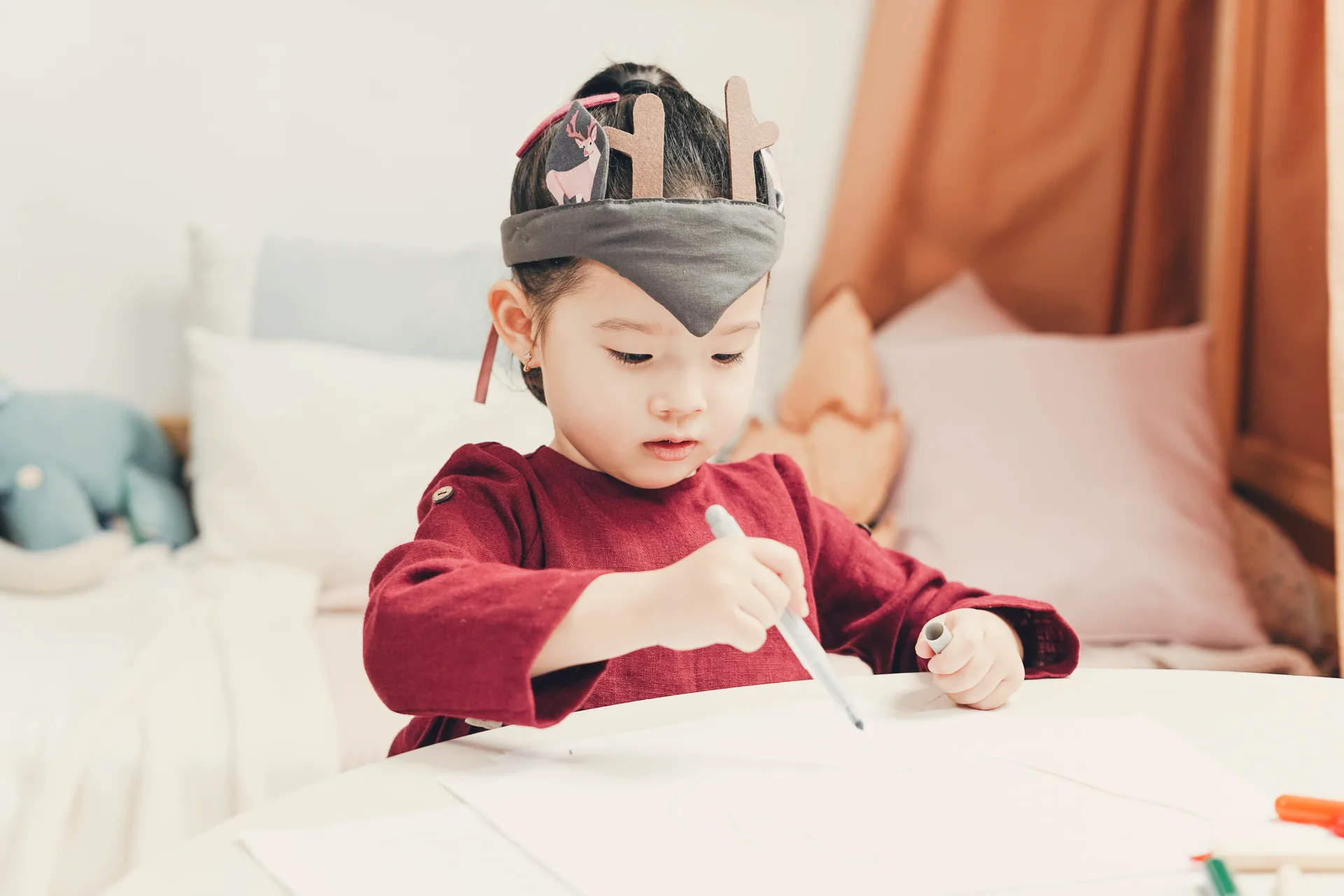
Art classes for toddlers in Singapore, at ages 3 to 5, should teach exploration before accuracy: making marks, naming and mixing colours, handling paint and clay, and talking about the picture. Singapore's preschool guidance asks for open-ended art with no templates, and REMAT, taught in OpenKids Art Programmes, starts colour at three with proper names and two-colour mixing.
A timetable tells you when a toddler art class meets. It does not tell you what a three-year-old is meant to learn there, and that matters. A class for ages 3 to 5 is not a smaller version of a class for ten-year-olds, and a good one looks almost nothing like a colouring worksheet. This guide sets out what children of this age can usually do, what Singapore's own preschool framework asks of art, and how the first stages of REMAT, the spiral art curriculum developed in Singapore by TAFA Group, the education group behind OpenKids, turn both into lessons.
What Most Children Can Do From 3 To 5
The US Centers for Disease Control and Prevention (CDC) publishes developmental milestones: things most children, 75% or more, can do by a given age. A handful of them bear directly on art. They describe what is typical, not how talented a child is, and the CDC's advice is simple: if you have concerns about your child's development, talk with your child's doctor.
- 3
- What Most Children Can DoDraws a circle when shown how. Strings large beads. Asks who, what, where and why.
- What It Means For An Art ClassShort, hands-on tasks. The teacher shows a mark, then the child finds their own.
- 4
- What Most Children Can DoNames a few colours. Draws a person with three or more body parts. Holds a crayon between fingers and thumb, not in a fist.
- What It Means For An Art ClassColours get their proper names. First figures appear. A finer grip gives more control of line.
- 5
- What Most Children Can DoPays attention for 5 to 10 minutes during activities. Tells a story with at least two events. Writes some letters of their name.
- What It Means For An Art ClassProjects run in short stages. Children can be asked for the story behind a picture and can talk about their own work.
Two things follow. Attention is short: a five-year-old who stays with one activity for five to ten minutes is right on track, so a well-run class for this age changes material, pace or activity more than once. And a recognisable figure is a four-year-old milestone, not a three-year-old one: most children draw a person with three or more body parts by four. By five, most can tell a story with at least two events, which is a good moment to start asking what is happening in a picture. A class that expects a recognisable drawing from every three-year-old is asking for more than most children that age are expected to do.
Three Ways Young Children Make Art
Singapore's Ministry of Education guides how preschools approach art through its Nurturing Early Learners (NEL) framework, which sets broad principles for the curriculum of children aged four to six: Nursery 2, Kindergarten 1 and Kindergarten 2. Its learning goals for this area are simple. Children should enjoy art, express ideas and feelings through it, and learn to appreciate it. The NEL educators' guide for Aesthetics and Creative Expression then describes three kinds of mark-making and art-making that teachers meet in these years.
- Exploration. Children discover that movements make lines, textures, shapes and forms. The work often looks random and uncontrolled, and the motion itself is part of the joy.
- Predictability and regularity. Children notice which action makes which mark. Marks become more regular, and beginning shapes appear, such as a drawing of a person.
- Symbolic and representative. Marks become deliberate. A drawing stands for a person, an object or a story, sometimes with the child's words or gestures alongside it.
The guide is explicit that this is not a ladder. A child moves between the three depending on intent, preference and how familiar a new tool or material is. A four-year-old who draws careful figures in crayon may go straight back to exploring when handed a brush and a new paint. That is normal, and it is learning. The section ends on the point to remember: a child's art is not merely a display of skills or a test of how accurately they represent the world. It should be valued first as an expression of their own thoughts and ideas.
Open-Ended Art Not Step-By-Step Craft
The same guide asks teachers to keep art open-ended rather than product-focused with step-by-step instructions. It describes what open-ended art looks like: there is no sample for children to follow or template to use, there is no right or wrong way to explore and create, and the experience is based on the child's choice. Routines such as tidying up still apply. The reason it gives is practical. When children's ideas are valued, their creativity, problem-solving, self-concept and confidence grow.
This is where a toddler class can quietly go wrong. Twenty identical paper animals on a wall look impressive at pick-up, but they show what the teacher planned, not what the children thought. REMAT writes the same principle into its Atman module, which puts the child at the centre: teachers never draw over a child's imagination, and each child observes, questions and solves in their own way. Confidence grows from there.
What REMAT Teaches From Age 3
REMAT is a spiral curriculum, built on the psychologist Jerome Bruner's idea that a child need not wait to meet a big idea. They meet it early, in a form they can hold, then meet it again, later and harder. Colour is the clearest thread. It returns at every stage from age 3 to 18, and the first three stages cover exactly the preschool years.
- 3–4
- StageFirst Acquaintance
- What Colour Means HereLearn the proper names of colours and mix two of them
- 4–5
- StagePioneering
- What Colour Means HerePut complementary colours to work
- 5–6
- StageBreakthrough
- What Colour Means HereTell analogous, complementary, warm and cool colours apart
Set that beside the CDC list and the two line up. Most children name a few colours by four, and REMAT gives them the proper names and a first act of mixing at three to four, while the words are arriving anyway. Complementary colours follow at four to five. By five to six, the work moves on to colour families and to warm and cool. The artists return in the same way: Paul Klee appears at ages 3–4 and again at 4–5, met each time by a slightly older child.
Colour is one thread among five modules. Theme means every lesson begins with a theme rather than a textbook, led by questions. Multi lets one idea take more than one form. Extend takes art beyond the studio door. Regroup rotates classes and teachers as children grow, so each change opens a new field of art. At three, most of this simply looks like curious, well-organised play, which is exactly what it should look like.
Six Questions To Ask Before You Book
Whichever provider you visit, these questions separate an art class from a craft session.
- Is there a sample everyone copies? If every finished piece looks the same, the lesson was a template.
- Does an adult ever draw on a child's work? A teacher can show a technique on their own paper. The child's paper should carry the child's own marks.
- Which materials will my child use? Crayon, paint and modelling clay each teach something different about line, colour, shape and texture.
- Are colours and lines given names? Singapore's preschool guide suggests teachers introduce words for lines and colours, so children can talk about their own work.
- How is my child placed? Age is a rough guide. What the child can already do is a better one.
- What happens after the first class? You should see every fee in writing before you are asked to decide anything.
How OpenKids Starts At Three
OpenKids Art Programmes run from age 3 to 18 and are taught through REMAT from the first stage. Children are placed by readiness, not birthday, so a young three and an eager four are each placed on what they can already do. Because the curriculum is a spiral, nothing learned at three is a dead end: the colour names of First Acquaintance become the colour system studied at six to eight and, much later, a personal palette in the portfolio years. Our art learning roadmap from 3 to 18 shows the whole path, and our guide to when to start art classes covers the readiness signals in more detail.
The first trial class is free, and every fee is shown in writing before your family decides. Campuses are in Singapore and Kuala Lumpur. A campus replies on WhatsApp within 48 hours, and the HQ WhatsApp line, +65 8990 1988, replies the same day.
Frequently Asked Questions
What age can a toddler start art classes in Singapore?
OpenKids Art Programmes take children from age 3, placed by readiness rather than birthday. More useful than the exact age is whether your child enjoys making marks and can stay with an activity for a few minutes. The first trial class is free, so you can see how your child responds before deciding.
Should my three-year-old's drawings look like something?
Not necessarily. By three, most children can draw a circle when shown how; drawing a person with three or more body parts is a milestone most children reach by four, according to the CDC. Random-looking marks at three are exploration, which Singapore's preschool guide treats as a normal way of making art.
Is colouring inside the lines a good way to learn art?
It practises hand control, but it is not open-ended art. Singapore's NEL guide describes open-ended art as having no sample to follow, no template and no right or wrong way to create. An art class should give children real choices.
What does a three-year-old learn about colour?
In REMAT, children aged 3–4 learn the proper names of colours and how to mix two of them. Complementary colours follow at 4–5, then analogous, warm and cool colours at 5–6. Colour returns at every later stage up to 18, each time deeper.
How much do toddler art classes cost in Singapore?
Fees differ from one provider to another, so ask each one for the full cost in writing. At OpenKids, the first trial class is free, and every fee is shown in writing before your family decides. Our market guide to what art classes cost in Singapore explains what drives the differences.
How quickly will I hear back after I enquire?
An OpenKids campus replies on WhatsApp within 48 hours. The HQ WhatsApp line, +65 8990 1988, replies the same day.